The internet: the final frontier. A near-infinite virtual space where anything and everything can be found.
 |
| This is what Mozilla Firefox browsing the web looks like. |
 |
| Above: Internet debates |
But how is the internet affecting
us? There are those among us who claim that the internet is an infernal device
lowering our intelligence. And of course, on the internet, where there is one opinion, there is always
a second one in complete disagreement.
So who is right? Is it Carr, who tells a charming little anecdote about how he can no longer focus on lengthy articles anymore, or Shirky, who scoffs and says that there will always be fearmongers where new technology rears its head?
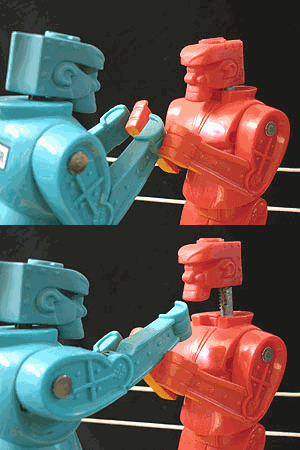
In the Blue Corner: Carr
Carr starts his article off with, in this writer's opinion, a completely useless anecdote about his inability to concentrate. He even goes and finds some of his buddies who agree with him "“I can’t read
War and Peace anymore,” he [Bruce Friedman] admitted. “I’ve lost the ability to do that. Even a blog post of more than three or four paragraphs is too much to absorb. I skim it.”"
Just what is that proving? I've got a cute anecdote of my own. When a book interests me, I'll devour it. I can still knock out a 900 page novel in a few weeks, if it holds my attention. But when long-winded academic papers crop up, is it really so surprising many people skim them?
Thankfully, that's not the end of Carr's article. He goes on to very clearly explain that anecdotes are no basis for an argument (thank goodness, or I might have thrown something).
Let me summarize the rest of the article for you, because honestly, it's really long and pretty boring.
 |
| Suddenly the term "Google Android" takes an ominous turn. |
1. Technology changes how we think and how our brain works
2. The internet in particular, not only does this, but also absorbs older technology (ie, maps, phones, televisions) and molds them into its own image.
3. Google wants to turn all our brains into super-efficient computers
4. This kind of worrying has happened with just about every major technological advancement (specifically citing the invention of written word, and the invention of the printing press).
5. Yes, you should be skeptical of my [Carr's] skepticism, but I'm still going to be skeptical.
In the Red Corner: Shirky
Shirky starts off by acknowledging all the doomsday prophecies concerning technologies. "these amateurs [of media] produce endless streams of mediocrity, eroding cultural norms about quality and acceptability, and leading to increasingly alarmed predictions of incipient chaos and intellectual collapse"
.
However, right off the bat, Shirky comes out swinging. He states that this kind of hysteria happens every time something new appears (a phenomena that even Carr agrees with).
The rest of his article can be summed up very succinctly: With the expansion of any new type of media, there is always an immediate explosion of low-brow trash that seemingly heralds the end of civilization. However, this is always followed by a growth of knowledge and art. Before there can be Shakespear, there must be really bad erotic fiction. We just happen to be living in that period of growth and expansion, which explains Justin Beiber.
So Who's Right?
I'm inclined to believe Shirky. History backs him up on this, and why should it be this event that breaks the pattern? The printing press didn't ruin us. Rock n' Roll didn't ruin us. The internet sure as hell won't. Carr admits his worries are based on nearly nothing but his own paranoia ("And we still await the long-term neurological and psychological experiments that will provide a definitive picture of how Internet use affects cognition.").
Even if the internet does affect how are minds work (and I really have no doubt that it does), I don't think this is a bad thing. I believe that one of humankind's strongest attributes is our mind's ability to rewire itself to best serve our needs. Society is heading in this direction. Our minds need to adapt to it.
I'll leave with a quote from Charles Darwin: It is not the strongest of the species that survives, nor the most intelligent that survives. It is the one that is the most adaptable to change.